Good morning from Bangladesh. I am very touched and honored to be invited and to speak in front of you. Our organization, Christian Commission for Development in Bangladesh (CCDB) has been working in Bangladesh for 52 years for the vulnerable community. And I am just a social development activist trying to raise my voice where the vulnerable community cannot reach. That’s all I do.
Thank you, Paul, for your profound and prophetic reminder that justice, economic fairness, protection and community are not optional parts of faith, but they are faith in action. Your reflection challenges us, especially those of us in faith-based organizations and churches, to confront the entire eco systems we are part of and to ask whether our structures truly reflect the Gospel’s call to justice, generosity, and community.
Bangladesh
Here is some contextual information about where I am from: I am from Bangladesh, a densely populated country with over 170 million people. Despite Bangladesh’s anticipated graduation from Least Developed Country (LDC) status by 2026, economic inequality continues to deepen. The top 10% of citizens controll approximately 58% of national wealth, while the bottom 50% hold just 19% of total income. Poverty has surged to 28%, up from 18.7% in 2022, with 9.35% living in extreme poverty. In rural areas, 35% of people still live below the poverty line, struggling with landlessness, food insecurity, and poor health services. Child labor remains a persistent injustice, with 3.6 million children engaged in unsafe or exploitative work. The ready-made garment (RMG) industry – Bangladesh’s largest employer, exemplifies the nation’s cheap labor paradox: while it powers exports, it relies on a minimum wage of only Tk 12,500 (≈ US $115), one of the world’s lowest for the sector. Workers, mostly women, face substandard living conditions, long hours, and frequent abuse. The devastating Rana Plaza collapse in 2013, which killed over 1,100 workers, remains a stark symbol of systemic negligence and the urgent need for stronger worker protection and accountability.
Debt economy
Schenderling’s critique of the global “debt economy” also resonates in Bangladesh, where the public debt-to-GDP ratio rose from 27% in 2014–15 to 37.6% in FY 2023–24, projected to exceed 40% by 2025. The reflection warns that this debt-fueled, export-dependent model perpetuates extraction – profits flow North while the costs of poverty and environmental damage remain South.
I think Paul’s sharing was very prophetic. The global financial system is built on perpetual extraction, indeed. Bangladesh is a country of many law regulations but we hardly see any implementation of them. In these circumstances, Christian NGOs cannot claim neutrality in this system. We need to raise our voices. We need to be very careful how we make our investments, our procurement choices and how we choose our theological narratives. Those have to be examined. Are we unconsciously aligning with an economy that commodifies people or creation?
“The policies are increasing, but the service and the support are decreasing”.
Equal accountability
Faith-based organizations and churches often operate with noble intentions but within structures shaped by the same inequities we seek to challenge. Many of our institutions depend on donor funding from the Global North; funding that, while generous, sometimes carries hidden power imbalances, priorities and conditionalities. It’s a very top-down process. It’s hierarchical and it’s about control. This reality can unintentionally reproduce the very hierarchies of empire that Paul Schenderling critiques: those who control capital also control priorities, narratives, and decision-making.
What we see is a lack of trust. As we see that the resources are going down all over the world, there is a saying now in our NGO sector in the South, in particular in Bangladesh: “the policies are increasing, but the service and the support are decreasing”. What we seek instead of having a top-down process is an investment into a horizontal partnership, an equal relationship that has equal transparency and equal accountability. True partnership across boundaries begins with listening to each other. The South has a lot of merits and knowledge that can be also shared with the North.
Organizational culture
This analysis challenges faith-based organizations and churches to examine their internal structures as well. Many operate within donor-driven, top-down systems that mirror the very inequities they seek to end. To embody justice, institutions must decentralize power, empower local leadership, emphasize inclusion with empowerment, especially for women and youth and embed accountability and participation at every level. Internally, they must ensure ethical coherence: fair pay, transparency, and care for mental and spiritual well-being. “A just mission,” the reflection notes, “cannot be built on unjust internal practices.”
Inside our faith-based organization and churches, we need to reimagine both structure and spirit. What we see also in the South is that the church has a lot of centralized power, as the head of the church has a lot of decision-making power. We believe that everything can be controlled from the headquarters. We see that local leadership especially of young people and women is not encouraged. But justice cannot be administered from headquarters. It must be lived and owned by the local. Therefore, we need to have ethical coherence within our organizational culture. If we don’t treat our staff well, if we are not transparent, if we don’t compensate properly and if we do not have a participatory decision-making process, we are just having a camouflage. We are not really following what Christ has demonstrated by giving his life for us. Issues of trust, transparency, equitable pay, care for mental and spiritual wellbeing are not administrative details. They are the expression of justice.
Many faith-based organizations and churches operate within donor-driven, top-down systems that mirror the very inequities they seek to end.
Economic discipleship
What is needed is a shift toward “economic discipleship”—rethinking investments, spending, and operations to prioritize fairness, sustainability, and community resilience. Churches and NGOs can lead by building community economies rooted in sharing, stewardship, and cooperation, turning faith into tangible social transformation.
As Paul Schenderling said, we should strengthen community economies. In CCDB, we follow a forum-based approach: we encourage a community-based savings and credit system where people become the owner of their own resources. With CCDB we empower them until the moment when they are able to manage their own money, and then we leave it to them for community ownership. This is how we work on community economies and community interdependencies.
Finally, the response urges partnerships between the Global North and South to move from one-way charity to mutual transformation, grounded in listening and humility. The global Church, it concludes, has a unique role in modeling a new kind of economy—one where relationships outweigh returns, and justice replaces control.
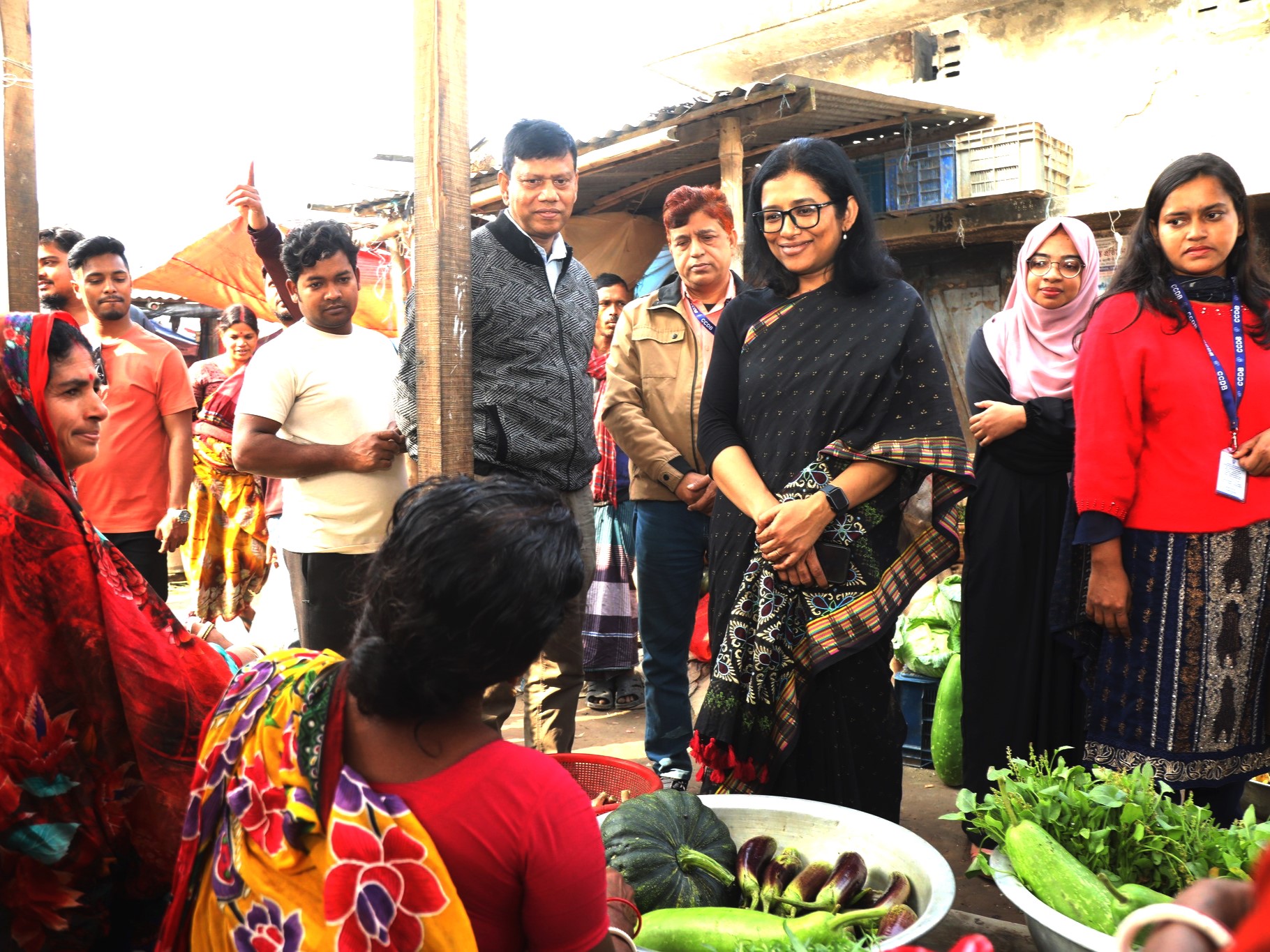
Juliate K. Malakar is executive director of the Christian Commission for Development in Bangladesh.
Photo: Juliate K. Malakar