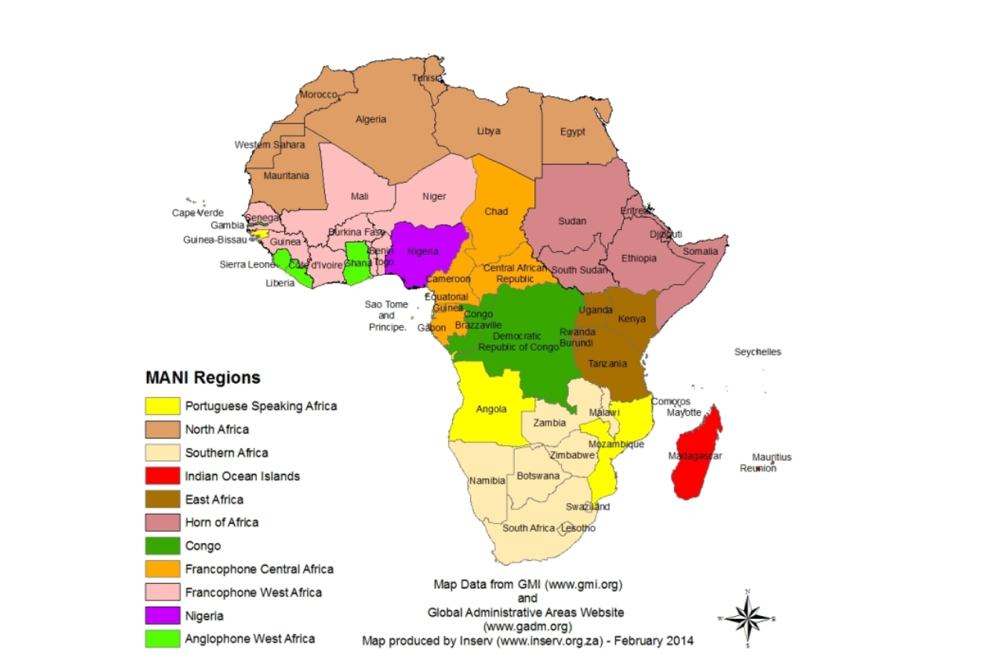
“Go North”, een devies van MANI (Movement for African National Initiatives), wijst op de toewijding van de Afrikaanse zendingsbeweging om een bijzondere verantwoordelijkheid op zich te nemen voor de Sahel-regio en Noord-Afrika. Met name de Franssprekende landen van West- en Centraal-Afrika (26 Afrikaanse landen zijn Franssprekend) zijn door hun taalverwantschap in een bijzondere positie, wat Franstalige mobilisatie voor zending extra belangrijk maakt.
Dat was een van de uitkomsten van de MANI 2026 Consultation. Meer dan 400 invloedrijke Afrikaanse zendingsleiders uit zo’n 40 landen kwamen bijeen in Abidjan, Ivoorkust (9-13 maart 2026), waaronder vertegenwoordigers van de diaspora, partners en 40 jonge leiders, om cruciale kwesties te bespreken die de toekomst van de zending in Afrika bepalen. Onder de aanwezigen waren Engelstalige, Franstalige, Portugeestalige en Arabischsprekende Afrikanen.
MANI werd in maart 2001 in Jeruzalem opgericht met 320 afgevaardigden uit 36 landen voor de Afrikaanse Millenniumconsultatie. Sindsdien heeft de organisatie bijeenkomsten gehouden in Nairobi (2006), Abuja (2011) en Addis Abeba (2016). De bijeenkomst van dit jaar duidde op de ontwikkeling van een Franstalige missiologie, omdat het de eerste keer was dat MANI-consultaties plaatsvonden in een Franstalig land in Afrika. Dit onderstreept het unieke en strategische belang van Franstalig Afrika ten opzichte van de Franstalige wereld. Een belangrijke focus van MANI ligt op het bereiken van Noord-Afrika met het evangelie, een regio die ooit een grote christelijke aanwezigheid kende. Franstalige christenen uit West- en Centraal-Afrika kunnen, dankzij de taalverbinding met landen als Marokko, Tunesië en Algerije, effectief deelnemen aan deze missiestrategie en mobilisatie.
In de Abidjan Declaration lezen we:
MANI, als pan-Afrikaanse, inheemse zendingsbeweging, is ervan overtuigd dat de Kerk in Afrika een cruciale rol te spelen heeft in de vervulling van de grote opdracht in de 21e eeuw. We bevinden ons op een kairos-moment voor de Kerk in Afrika. Afrika is nu het continent met de grootste christelijke bevolking, met in totaal ongeveer 750 miljoen christenen. Het zwaartepunt van het wereldwijde christendom is onmiskenbaar naar het zuiden verschoven. Deze bijeenkomst is niet alleen een viering van deze theologische realiteit, maar ook een confrontatie met de zware verantwoordelijkheid die dit op de Kerk in Afrika legt. De Kerk in Afrika is volwassen geworden. Ze draagt de last van 750 miljoen christenen op een continent waar 1 op de 5 te maken heeft met vervolging. Een continent waar moslims Jezus in dromen ontmoeten in de Sahel. Een continent waar huisgemeenten groeien in de steden van Tertullianus en Augustinus en waar een nieuwe generatie jonge Franstalige missionarissen gehoor geeft aan de roep om in trouwe gehoorzaamheid aan God naar de moeilijkste plekken te gaan.
De volgende paragrafen zijn integraal overgenomen uit de Abidjan Declaration:
| Africa: Now a Missionary-Sending Continent Africa’s missionary identity is not new – it is woven into Scripture itself, from the Ethiopian eunuch of Acts 8 to the theological giants of Alexandria, Carthage, and Cyrene. The era of Africa as primarily a mission-receiving continent is over. Sending hubs now operate in Lagos, Nairobi, Jos, Ibadan, Owerri, Addis Ababa, Yaoundé, Lome, Abidjan, and Johannesburg. Workers are deployed among the Fulani in Guinea, in North Africa, and in the Francophone Sahel. The infrastructure to send out more missionaries from Africa exists. There is a will to multiply it, fund it from within, and direct it strategically toward those who have not yet heard the good news. God calls every church in Africa to be a sender – not eventually, but now. Missions: Strategic Significance of Francophone Africa The choice of Abidjan was missional and intentional, not logistical. The Francophone Sahel, stretching from Senegal and Mauritania through Mali, Burkina Faso, Niger, Nigeria, Sudan, Eritrea, Cameroun and Chad, is one of the most concentrated mission frontiers on earth, home to the Kanuri, Soninke, and Fulani and various unreached peoples’ groups. Francophone African believers carry linguistic and cultural proximity to these communities that no other part of the global church possesses. The consultation renews the longstanding MANI call to Go North. We commit to dismantle the structural Anglophone default that has persisted even in pan-African gatherings by ensuring that Francophone and Lusophone voices shape strategy at the highest levels. Africa: The Suffering Church One in five Christians in Africa currently faces some form of persecution. In Nigeria, Niger, Cameroon, Chad, Mali, Burkina Faso, the DRC, Mozambique, and North Africa violent extremist groups target believers through massacres, abductions, and forced displacements. This consultation receives the reality of Christian persecution with theological clarity, rather than despair. Persecution is not the end of mission – it is frequently the engine of mission. In fact, persecution does not mean the abandonment of the believer, in a theological and missiological sense, persecution purifies the Church. The Church is called to prepare believers and church workers theologically and practically for suffering. The Church is to offer concrete solidarity across the body and to pursue both intercessory prayer and credible legal advocacy on behalf of persecuted communities. African Diaspora: Divine Deployment The spread of African believers globally is reframed not as displacement but as sovereign deployments. African Christian diaspora and missionaries are planting churches in European, Asian, North American, Latin American, Oceanian cities etc., where indigenous Christians have retreated, reaching migrant communities, and carrying the gospel into spaces where traditional missionaries cannot gain access. Second-generation diaspora Africans – culturally Western but ethnically African – are uniquely equipped for the cross-cultural complexity of the remaining mission task. The consultation declares plainly: your presence in the diaspora is not a distance from Africa’s mission. It is by divine orchestration an extension of Africa’s mission. |
Zie ook: Rev. Dr Israel Oluwole Olofinjana: African Missiology: Reflections on African Development and African Mission Movement
Zie ook: Jan Wessels: REIMAGINING AFRICAN INITIATIVES: MANI 2026